Recently I was offered an excellent post doc position in the lab of Prof. John Silander at the University of Connecticut. This is big for me - it means my years as a grad student (6 so far) are coming to a close, I'll be working in a lab whose research I've been following for many years now, I'll continue to work in plant systems, I'll be applying and greatly expanding my analysis and programing skill set, and on a practical level, I can work in this lab and continue to live on Long Island, where my wife has a good job as an Assistant Professor at Hofstra Medical School. The logistics of my position are bit complicated, but all setup. Those are some of the good things. The challenge has been wrapping up my thesis. You would think that after 6 years my manuscripts would be mostly complete, but reflecting back on my experience, I have begun to realize how little time I spent on my thesis compared to all the other things I've done in grad school. Having not taken any biology since high school, I spent a lot of time taking classes. I also took a lot of classes focusing on math and statistics in ecology. I've done a lot of departmental service related things, which has led me to believe that receiving a Departmental Service Award is both a good and bad sign. And I've been involved in, and continue to be involved in, side projects. Add in TAing, peer reviews for journals, etc., etc., - you get my point. This all adds up to the last few months and next few weeks as being a crunch time for writing, and through this time I've been keeping my copy of William Strunk and E.B. White's The Elements of Style close at hand.
Why the Elements of Style? It is not the book that was used in my college writing class (that was The Bedford Handbook). It's not about scientific writing. For all I know, it may not even be what my writing friends would recommend. But it is highly recommended by many professors in my department, which is why I picked it up in the first place. Regardless of why I began using this book, it has become quite important to me as a writer. In particular, it has two meanings for me. One, contained within its short descriptions of the rules of writing is the promise that I can become a better writer. I read one of the 'Principles of composition' and think, 'Yeah, that does sound better. I can do that in my writing.' Or I can look at the one of the 'Elementary rules of usage', and then go back to my manuscript, search for instances in which I break a rule, and fix it. I can make my writing cleaner, clearer, and more concise. The second meaning is a bit more symbolic. I like to read a bit from this book before I start writing for the day. I don't necessarily set out to apply what I read, I just find that it puts me in a writing mood. So at the end of a long day of grading problem sets or writing R code, if I look at my copy of Strunk and White, and I know that I didn't crack it open that day, I know I probably didn't do any writing. Sure, this is followed by a pang of guilt, but it also comes with an increased motivation to get some text down the next day, which is ultimately going to get me through writing my PhD.
And that's what Strunk and White has come to mean to me.
Monday, May 13, 2013

Wednesday, March 20, 2013
The Excitement of Data
I am embarrassed to admit it, but I am just now getting around to analyzing the data I collected from the 2012 field season. I do tend to spend the winter months plugging away at computer based projects, and this year has been even busier than years past. I've been working on developing new tools for SDMs and finishing my demographic model sensitivity analysis project, as well as keeping up with my TA obligations and working on an addition to the climate change paper I've discussed previously here. But this post isn't meant to talk about being busy, it's to express my excitement about analyzing another seasons worth of Glossy Buckthorn data.
One data set I've collected that I'm particularly keen to look at is from a small buckthorn population in northern New Hampshire, on forest service land. In the fall of 2010 I marked approximately 150 individual plants at this site. Unexpectedly, during the late summer/ early fall of 2011, this site was mowed. I lost most of my tags, but about 45 remained connected to the cut plants. Glossy Buckthorn is somewhat notorios for its ability to re-sprout after damage - this is one characteristic that makes it hard to manage. Rather than abandon the site altogether, I decided I would measure the basal diameters (also called diameter at ankle height, or DAH) of the remaining tagged plants. Here is a preliminary plot of what these results look like, showing basal diameter in 2010 versus basal diameter in 2012.
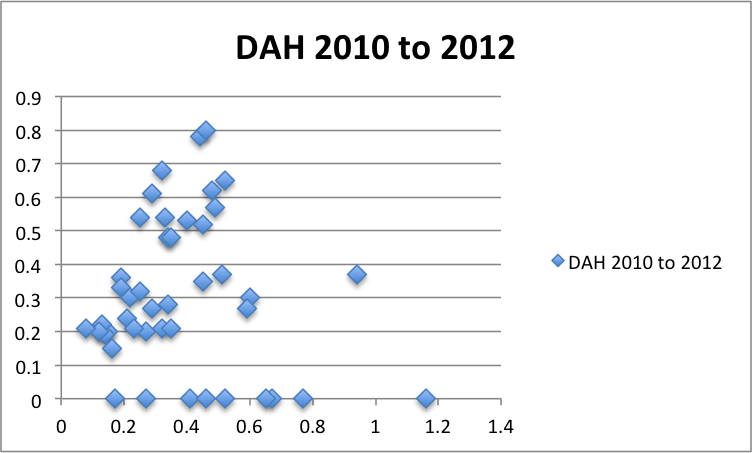
The x-axis is the DAH in 2010 and the y-axis is DAH in 2012. I can see that some plants are not recovering, however it looks like many have grown quite a bit. Also, all of the plants with a DAH > 0 represent some form of regrowth - either regrowth of the original tagged stem or growth of new sprouts. A tenacious plant, for sure. I wrote a bit more about this particular site in another post as well.
Simple preliminary plots like this one have me looking forward to poking at my data and getting to my full analysis over the next few weeks.
One data set I've collected that I'm particularly keen to look at is from a small buckthorn population in northern New Hampshire, on forest service land. In the fall of 2010 I marked approximately 150 individual plants at this site. Unexpectedly, during the late summer/ early fall of 2011, this site was mowed. I lost most of my tags, but about 45 remained connected to the cut plants. Glossy Buckthorn is somewhat notorios for its ability to re-sprout after damage - this is one characteristic that makes it hard to manage. Rather than abandon the site altogether, I decided I would measure the basal diameters (also called diameter at ankle height, or DAH) of the remaining tagged plants. Here is a preliminary plot of what these results look like, showing basal diameter in 2010 versus basal diameter in 2012.
The x-axis is the DAH in 2010 and the y-axis is DAH in 2012. I can see that some plants are not recovering, however it looks like many have grown quite a bit. Also, all of the plants with a DAH > 0 represent some form of regrowth - either regrowth of the original tagged stem or growth of new sprouts. A tenacious plant, for sure. I wrote a bit more about this particular site in another post as well.
Simple preliminary plots like this one have me looking forward to poking at my data and getting to my full analysis over the next few weeks.
Saturday, January 5, 2013
Seeing the Forest, or The Importance of Writing
I'm now well into my 6th year of grad school, and partly because of that, I've been doing a lot more writing than in years past. I'm writing job applications, I'm writing manuscript drafts, I'm writing (occasionally) here on this blog. And I'll be honest, writing is not always as easy as programming or field work. In fact, it's almost never that easy. I haven't mentioned it much on the blog, but most of the research I do is actually quantitative and programatic in nature. I spend little time in the field compared to how much time I spend working on R code. That's not a complaint - just a fact. As the amount of writing I do increases, especially for job apps, it strikes me that this process is very important to help me focus on the bigger picture of my research goals.
If asked what type of research I do, I'll often say, "I develop quantitative methods to answer questions in conservation biology". Where do those questions come from? For the past five and half years, they have mostly come from sitting around with my colleagues, discussing some paper, and thinking, "Yeah, but what about this thing they don't talk about ..." or "That seems good, but what would you do to make it even better ...". Or from talking with other Ecologists and Evolutionary Biologists (particularly my committee members) about some pattern that just hasn't been explained that well. In a large part, that's how my research project on non-native species lag-phase dynamics has come about. Let me delve into my own thesis project a bit more - I took this question about lag-phase dynamics (i.e. what's going on during that lag-phase) and said, "ok, given some data, how might I go about understanding the processes going on during that time? I can build a model, simulate the most likely processes, and see if the simulation matches reality." (There you go folks, a description of my PhD in two sentences.) I decided on the "most likely processes", chose the types of models I would need for simulation, and got started. This is a good project management technique - everything got broken down into little pieces. Each piece was further subdivided. The subdivisions get translated into programming projects. The subdivision continues from there. So where I am now is at a point of wrapping up multiple projects, most of which involve finishing of pieces of code here and there. And it takes a conscious effort to step back and look at the project as a whole. (It doesn't help that the integration of each part of the project is the last step!) And that's where the writing comes in. I'm forced to step away from my coding for a bit, and describe the research I do. It's not writing code - it's posing questions relavent to conservation, then developing ways to answer those questions. And while I always know this, hours debugging an R script will pretty much clear my mind of everything not related to that script. So for now, I welcome that time dedicated to writing (like right now), and appreciate the focus it give me, so I'm not missing the forest for the trees.
Tuesday, December 18, 2012
Reviewing the causes of extinction due to climate change
This post is a few weeks late now, but I wanted to discuss a paper I co-lead with another student in my department, Abby Cahill, which recently became available online through the journal The Proceedings of the Royal Society B. We even got the cover photo for the print edition, which is pretty neat! You can access the abstract for the article here, and if you want a pdf, just drop me a line.
This article is the result of work a group of us students in E&E at Stony Brook did during, and following, a seminar lead by Prof. John Wiens. We set out to investigate how climate change has caused documented local extinctions. We employed systematic review methods, trying as best we could to create a replicable review study. This was the second systematic review that I participated in. The other review I worked on was with the Gurevitch Lab, in which we carried out a field synopsis and systematic review of invasive species research. As authorship order would indicate, I played a much smaller part in that review than this one. However, working with the Gurevitch Lab members during the early development of their review, I gained an appreciation for the usefulness of these review techniques. With that said, after writing our climate change review, and a follow up we just sent off for review on the causes of range limits, I do wonder if there are any ways to make literature reviews even better (more on that later).
Back to our review - on some levels what we really wanted to know is if climate change will cause local population extinctions because organisms reach some physiological limit (e.g. it's just too hot) or by some other means (e.g. interruption of some biotic process). Though my thesis research involves an invasive plant, many of my research interests, and most of my side projects in the Akcakaya Lab, fall squarely in the climate change / conservation biology realm. So this question really resonated with me. Carrying out the review yielded two major results. One, for those studies that identify the proximate causes of climate change related extinction, there are many more cases in which disruption of biotic interactions is the cause. Second, very few studies actually identify a proximate cause of extinction. This second point actually surprised me, but discussing our findings with more established conservation biologists, few shared in my surprise. Considering this finding, we also tried to outline some ideas for how we may pursue conservation research to address this lack of knowledge. Hopefully this review will be helpful to young scientists looking for research ideas.
Beyond this particular review and these particular results, carrying out this review and writing the paper made me start thinking about just how literature reviews are carried out. At this point, I would say that I am a proponent of the systematic review approach (for background literature have a look at Pullin and Stewart's ConsBio article or the Gurevitch Lab paper cited above - which is open-access). However, it is certainly not without its faults. For example, to my knowledge, the best way to carry out a repeatable literature search is to use a set of search terms in a database such as ISI's Web of Science. I've done searches in this particular database, and indeed, the results are replicable. However, there is a temporal bias in these databases, due to the fact that many articles published prior to the 1980s do not have digitally indexed titles or abstracts. Many of my professors have stressed the importance of not ignoring older literature, but how do we get this literature into reviews systematically? Also, there are many examples of these searches failing to find relavent literature. When this happens we face the question of whether to add literature that we know is relavent, thus making the search results less transparent, or leaving it out, which personally, leaves me with a funny feeling of failing to cover the full 'parameter space' of my potential data, if you will. I don't have any great ideas about how to address these issues. At the end of the day, I find some comfort in the idea that a thorough literature search may not return every relavent study ever published, but neither does a transect return information on every plant in a population (or even that transect, given observer error), and as with the transect data, if done correctly we can say we've thoroughly 'sampled' the population.
Another concern I have with systematic reviews is that they often entail extraction of some pieces of data from studies, to be further analyzed (e.g. the number of species examined or the documented causes of local extinction). This may seem pretty straight forward - the information I want has got to be in the paper, I mean, it was published! But in practice, data extraction can be quite difficult, especially when you are trying to extract from hundreds of papers with several people. We employed carefully crafted Google Forms, which despite our "carefulness" needed lots of editing once everyone started using them, and ultimately, lead to us going over our data set several times. An idea that I've been tossing around is to invite the original study authors to help in this process. Sure, this will not always be possible. Some authors will not have the time, some will not be able to be contacted, and of course, there's always the possibility that some will not be happy with the way you intend to include their study. I have no reason to believe this, but I have this funny feeling that someone is going to read our ProcB paper and say "I most certainly did identify the causes of extinction for this species!". To that I say, while the paper has been published, it doesn't mean the information shouldn't be updated. Perhaps a review should be an active process? A wiki of some sort? The review authors can set-up the structure, provide their assessment, and then the cited study authors can be invited to edit/add/remove information about their research - with some editorial control by the review authors I suppose. Sounds like a cool project to me. Also sounds like a lot of time and work. But perhaps another step forward for literature reviews?
Back to our review - on some levels what we really wanted to know is if climate change will cause local population extinctions because organisms reach some physiological limit (e.g. it's just too hot) or by some other means (e.g. interruption of some biotic process). Though my thesis research involves an invasive plant, many of my research interests, and most of my side projects in the Akcakaya Lab, fall squarely in the climate change / conservation biology realm. So this question really resonated with me. Carrying out the review yielded two major results. One, for those studies that identify the proximate causes of climate change related extinction, there are many more cases in which disruption of biotic interactions is the cause. Second, very few studies actually identify a proximate cause of extinction. This second point actually surprised me, but discussing our findings with more established conservation biologists, few shared in my surprise. Considering this finding, we also tried to outline some ideas for how we may pursue conservation research to address this lack of knowledge. Hopefully this review will be helpful to young scientists looking for research ideas.
Beyond this particular review and these particular results, carrying out this review and writing the paper made me start thinking about just how literature reviews are carried out. At this point, I would say that I am a proponent of the systematic review approach (for background literature have a look at Pullin and Stewart's ConsBio article or the Gurevitch Lab paper cited above - which is open-access). However, it is certainly not without its faults. For example, to my knowledge, the best way to carry out a repeatable literature search is to use a set of search terms in a database such as ISI's Web of Science. I've done searches in this particular database, and indeed, the results are replicable. However, there is a temporal bias in these databases, due to the fact that many articles published prior to the 1980s do not have digitally indexed titles or abstracts. Many of my professors have stressed the importance of not ignoring older literature, but how do we get this literature into reviews systematically? Also, there are many examples of these searches failing to find relavent literature. When this happens we face the question of whether to add literature that we know is relavent, thus making the search results less transparent, or leaving it out, which personally, leaves me with a funny feeling of failing to cover the full 'parameter space' of my potential data, if you will. I don't have any great ideas about how to address these issues. At the end of the day, I find some comfort in the idea that a thorough literature search may not return every relavent study ever published, but neither does a transect return information on every plant in a population (or even that transect, given observer error), and as with the transect data, if done correctly we can say we've thoroughly 'sampled' the population.
Another concern I have with systematic reviews is that they often entail extraction of some pieces of data from studies, to be further analyzed (e.g. the number of species examined or the documented causes of local extinction). This may seem pretty straight forward - the information I want has got to be in the paper, I mean, it was published! But in practice, data extraction can be quite difficult, especially when you are trying to extract from hundreds of papers with several people. We employed carefully crafted Google Forms, which despite our "carefulness" needed lots of editing once everyone started using them, and ultimately, lead to us going over our data set several times. An idea that I've been tossing around is to invite the original study authors to help in this process. Sure, this will not always be possible. Some authors will not have the time, some will not be able to be contacted, and of course, there's always the possibility that some will not be happy with the way you intend to include their study. I have no reason to believe this, but I have this funny feeling that someone is going to read our ProcB paper and say "I most certainly did identify the causes of extinction for this species!". To that I say, while the paper has been published, it doesn't mean the information shouldn't be updated. Perhaps a review should be an active process? A wiki of some sort? The review authors can set-up the structure, provide their assessment, and then the cited study authors can be invited to edit/add/remove information about their research - with some editorial control by the review authors I suppose. Sounds like a cool project to me. Also sounds like a lot of time and work. But perhaps another step forward for literature reviews?
Friday, November 23, 2012
Management and Resilience
The White Mountains of New Hampshire is the place that inspired me to study ecology. So when I was coming up with my PhD project I wanted at least some of my field work to be in this region. (As an aside, one of the bonuses of the PhD program at Stony Brook is that you can develop a project independent of your adviser's research program, so to some extent, you can choose where you want to work.) In fact, while I was developing my project, I contacted the Botanist for the White Mountain National Forest and asked him if there were any non-native plant species he thought were particularly concerning. Glossy buckthorn - that was his first answer. So as I've described a bit here, in 2009 I set up my first transect about a 1/2 mile or so from the trailhead of the Winniweta Falls Trail.

I'll leave a discussion of the physical characteristics of this site for another post. Today I want to share some of my observations from here, which I think demonstrate the tenacity of Glossy Buckthorn. In September of 2010, I marked 147 individual plants along three 30m transects in a field heavily infested with Glossy Buckthorn. This field was just one of several open fields in the area (along the Jackson Ski Touring trails, for those of you who are curious) that had a high density of buckthorn. I believe these areas are maintained as open fields to provide wildlife habitat for organisms such as moose.
A little out of the field of view of the picture above, I set down one of my three 30m x 1m belt transects, which contained 115 buckthorn plants. As you can see below, many of these plants are taller than my 2m measuring pole.
I received permission from the Forest Service to sample at this location, I even have a letter on official USFS letter head, so I was pretty confident that my site would go undisturbed after setting up my transects and tagging the plants. Plus, this isn't a high traffic area for hikers. But between my 2010 visit and my 2011 visit there were to major storms, including Hurricane Irene, that flooded the area, so I was expecting some impacts. But I was pretty shocked when I showed up the Fall of 2011 to this!
And here's that transect that had all of those greater than 2m tall plants.
As it turns out, there was some miscommunication and this locale was approved for a mowing. It would be foolish to harbor any bitterness about a destroyed site. After all, the forest service is just trying to manage this invasive plant and keep this wildlife opening, well, open. But I do have to wonder if the mower thought twice about running over orange flags, plants marked in a line with flagging tape, or plants clearly marked with shining little metal tags.
So, seeing this for what it was, I collected the tags I could find, measured the basal diameter of the plants who still had tags attached to them (hey, after all, that's a years worth of growth in basal diameter I could measure there, even if I couldn't say much about height), and left with the plan to come back in 2012 and see what happens. You see, buckthorn is notoriously tenacious - it re-sprouts quite readily. The most affective way to manage buckthorn is to cut it and immediately apply a weed killer (this is based on research reported in several papers, many from the Natural Areas Journal). I had a suspicion I would come back in a year and see plenty of re-growth. Of the 147 plants originally tagged, I was able to leave 44 and recover 45. That left 58 unaccounted for. Given how high the flood waters came from the two large storms that hit this area in 2011, I suspect that many of them are in the Ellis River or along its banks. This season I returned to Winn Falls and was tacken aback by the amount of re-growth.
I haven't completely entered and analyzed these data, but taking a quick peak, about 5 of the 44 left were dead. Three more were missing. And it looks like on average there was about 40cm of re-growth. Also, many of them had multiple basal stems. I suspect returning next year I will find many of these with fruit on them. Ultimately, these data may not make into my population model. My sample size is very small (38 plants - lost 8 and gained 2 this year). But I think these data are still interesting. They make me wonder how affective a management strategy that involves cutting every couple of years can really be. Also, before the mowing, this field was a giant reservoir of Glossy Buckthorn seeds. I can't help but think about the role this reservoir might play in the spread of buckthorn into nearby logging sites or down river.
 |
| Dense Glossy Buckthorn cover in an open field near Winniweta Falls Trailhead |
 |
| Transect 3 - Many buckthorn platns taller than my measuring pole! |
 |
| Winn Falls site after mowing |
 |
| Transect 3 - after mowing |
So, seeing this for what it was, I collected the tags I could find, measured the basal diameter of the plants who still had tags attached to them (hey, after all, that's a years worth of growth in basal diameter I could measure there, even if I couldn't say much about height), and left with the plan to come back in 2012 and see what happens. You see, buckthorn is notoriously tenacious - it re-sprouts quite readily. The most affective way to manage buckthorn is to cut it and immediately apply a weed killer (this is based on research reported in several papers, many from the Natural Areas Journal). I had a suspicion I would come back in a year and see plenty of re-growth. Of the 147 plants originally tagged, I was able to leave 44 and recover 45. That left 58 unaccounted for. Given how high the flood waters came from the two large storms that hit this area in 2011, I suspect that many of them are in the Ellis River or along its banks. This season I returned to Winn Falls and was tacken aback by the amount of re-growth.
 |
| Transect 3 - one year post mowing |
Monday, November 5, 2012
After the storm
I'm lacking time to do a fuller post these days, which is sad because I have several ideas bouncing around my head. I'll try to make some time later this week. In the mean time, this is just a quick note to say that I'm very curious what, if any, the affect of Hurricane Sandy will be on my Long Island field plots. I finished this season's work in the UNH area about a week and a half ago, and was planning to visit Caleb Smith last week, but obviously that plan was changed. For now, Caleb Smith is closed to the public, so it may be some time before I can finish this year's work. I'll do a post once I collect this data. Everyone stay safe for now.
Thursday, October 18, 2012
In the field with my wife
My wife is so awesome that she insisted on using two of her floating holidays to help me out in the field in my southern New Hampshire sites this past September. It was great to have Gina in the field for multiple reasons. First, not to get too cheesy, but I really enjoy hanging out with her. Second, field work goes so much faster with another person. Third, it was interesting to get some new ideas about doing field work from someone who isn't as tied up in the project as myself.
One of the best ideas Gina had for me was to draw a rough map for each of my quadrats, showing the general position of each tagged plant in the plot. At first, this seemed like an awful lot of work, but thinking about it a bit further, and failing to find a few of last seasons marked plants, made me reconsider. If you have ever tried to find tagged plants you know that sometimes it's very hard. A year's worth of debris has accumulated, often times hiding tags under a layer of compost. Some researchers employ tricks and tools such as using a metal detector. I have not gotten to this point - partly because I cant afford a metal detector. So, lacking a metal detector, I'll dig around in the duff for upwards of 30 minutes looking for a single tag. Here's what I imagine a quadrat map might look like.
The numbers indicate the tag number for each plant. Clumps of plants with sequential tags might be listed together with a general shape of the clump. Distinguishing characteristics, such as the presence of a particularly large tree would be noted. Etcetera. I really like this idea, and I don't think it will take much time to sketch out such maps in the field when tagging plants. Next season, as I prepare to make some of my sites longer term monitoring plots (i.e. places to go back to after I finish my PhD) I think I'll start making these quadrat maps.
 |
| Gina, ready to measure some plants! |
 |
| An example of a 'quadrat map' |
 |
| Happy field workers at the end of the day! |
Subscribe to:
Posts (Atom)